Queensland Religious Places
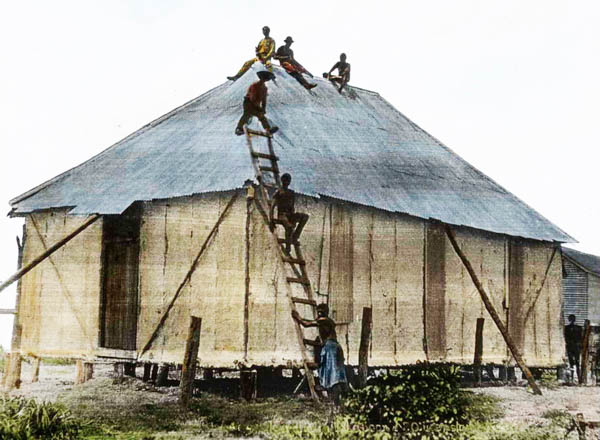
(c. 1893 Ludewig, Securing Territory Grey Architecuture and the German Mission of Cape York 1886-1919, 228)
| Mapoon Church | |
| Mapoon 4874 | |
| Moravian | |
| 1893 | |
| timber, coral | |
| Demolished | |
| Ganter, German Missionaries in Australia, http://missionaries.griffith.edu.au/qld-mission/mapoon-1891-1919; Ludewig, Securing Territory Grey Architecuture and the German Mission of Cape York 1886-1919, 225-235 | |
| 35x25 ft | |
| 1899 | |
| Replaced by new church | |
| Schneider 'You must not imagine a spacious and proud dome. No, the building was only 35 feet long and 25 feet wide. In consideration of the flooding brought about by the wet season, the building rested on posts. The roof was made from corrugated iron, and the framing from mangrove timber. Missionary Hey had felled the trees from which the posts and beams were fabricated in a swamp about 45 minutes from the mission house, and with the help of the blacks, transported them back to the site in the mission settlement; prepared them, set them up and joined them together. The interstitial spaces between the timber framing were filled with woven screens made from strong twigs that formed a structure for the lime paste infill. This is how the walls were fabricated, which incorporated three openings on each of the long sides of the building for the windows, and an opening at each end wall for a door. The gaps between the bearers and the floorboards were filled using countless timber wedges, and the entire floor was coated with a layer of quickly hardening lime wash. Coral, which has a high lime content, and which when burnt, extinguished and mixed with sand, produces a hard and uniformly white mortar, was used to paint the walls of the church both outside and internally (Ludewig 227). |
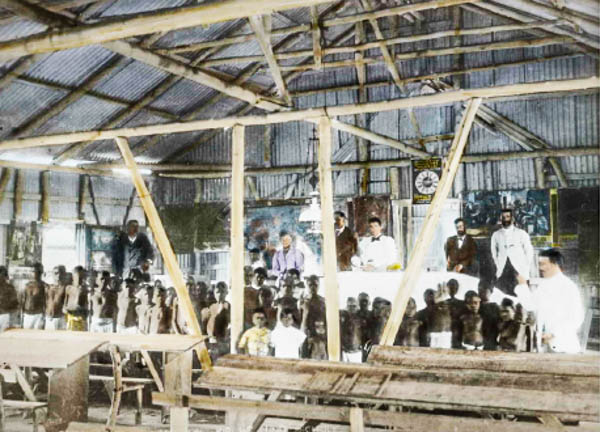
(Interior, c. 1893 Ludewig, Securing Territory Grey Architecuture and the German Mission of Cape York 1886-1919, 229)